
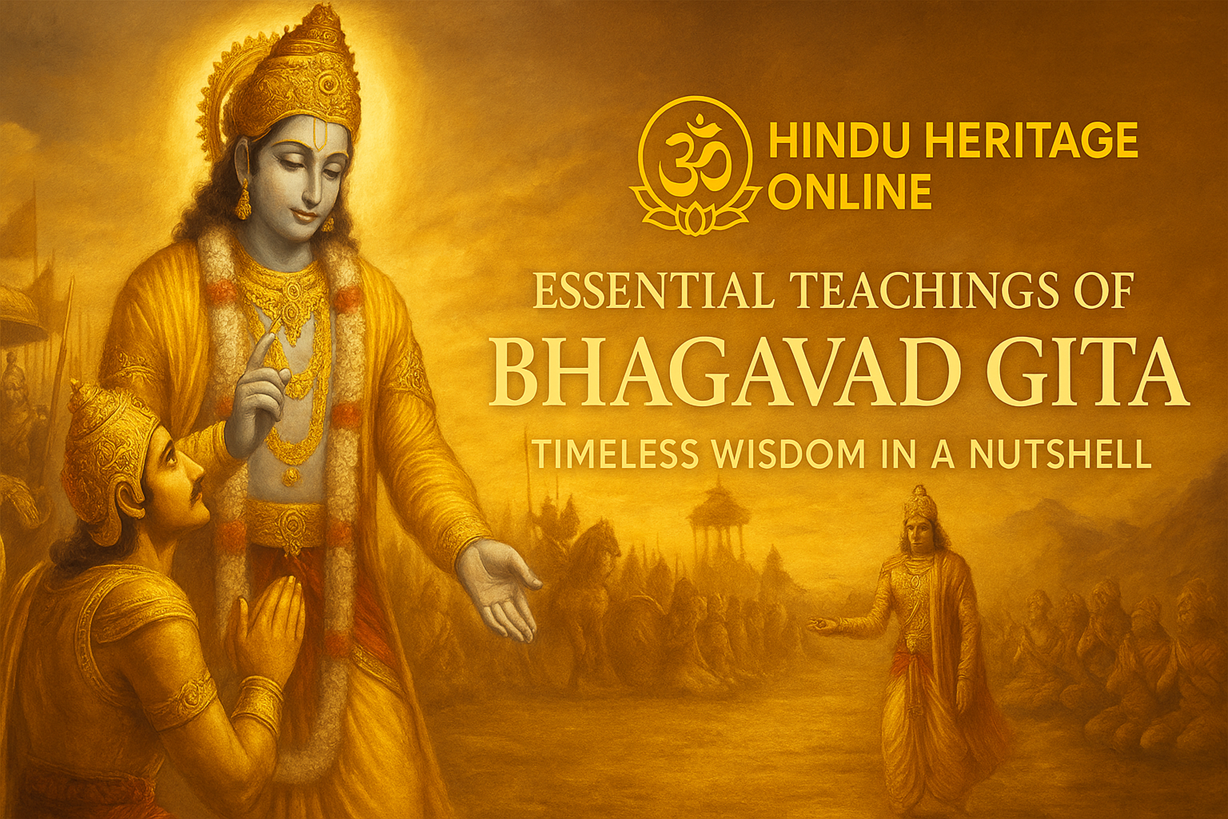
Essential Teachings of Bhagavad Gita: Timeless Wisdom in a Nutshell
Standing at the crossroads of duty and desire, facing an overwhelming challenge that shakes the very foundation of his beliefs, Prince Arjuna’s crisis on the battlefield of Kurukshetra mirrors the dilemmas we face in our daily lives. The Bhagavad Gita teachings that emerged from this profound dialogue between Arjuna and Lord Krishna continue to offer transformative wisdom for navigating life’s complexities with clarity, purpose, and inner peace.
The Context: A Universal Human Dilemma
The Bhagavad Gita, literally meaning “Song of God,” presents a conversation that transcends its historical setting. While situated on a battlefield, the real war being addressed is the internal conflict between our higher and lower natures, between duty and desire, between fear and faith. This makes Krishna wisdom eternally relevant for business leaders, students, parents, and anyone facing difficult decisions.
Teaching 1: Understanding Your Dharma (Righteous Duty)
“Better is one’s own dharma, though imperfectly performed, than the dharma of another well performed.”
The first and perhaps most crucial teaching of the Gita concerns dharma – our righteous duty based on our nature, circumstances, and capabilities. Krishna emphasizes that each individual has a unique role to play in the cosmic order, and fulfillment comes not from imitating others but from authentically expressing our own potential.
As a mentor working with entrepreneurs and professionals, I’ve observed that those who align their careers with their inherent nature and values experience greater satisfaction and success. The Gita teaches us to identify our svadharma (personal dharma) by examining our natural inclinations, talents, and the needs of our environment.
Practical Application: Before making major life decisions, ask yourself: “Does this align with my authentic nature and serve a greater purpose?” This dharmic approach to decision-making leads to more sustainable success and inner peace.
Teaching 2: Karma Yoga – The Art of Selfless Action
“You have the right to perform your prescribed duties, but you are not entitled to the fruits of your actions.”
Perhaps the most misunderstood yet transformative teaching is karma yoga – the path of selfless action. Krishna doesn’t advocate inaction or indifference to results, but rather freedom from anxious attachment to outcomes. This principle revolutionizes how we approach work, relationships, and personal goals.
Krishna teachings reveal that when we act with full commitment but without desperate attachment to specific results, several profound changes occur:
- Our actions become more skillful and effective
- We experience less stress and anxiety
- We remain open to unexpected opportunities
- Our service becomes more authentic and impactful
For Business and Career: Approach your work with excellence and dedication, but don’t let your self-worth depend entirely on specific outcomes. This paradoxical approach often leads to better results while maintaining emotional equilibrium.
Teaching 3: The Nature of the Eternal Self
“For the soul there is neither birth nor death. It is not slain when the body is slain.”
The Gita’s profound insights into the nature of consciousness address our deepest fears about mortality and identity. Krishna teaches that we are not merely physical bodies or even mental personalities, but eternal spiritual beings having temporary material experiences.
This understanding transforms how we view challenges, failures, and successes. When we identify with our eternal nature rather than temporary circumstances, we develop:
- Resilience in face of setbacks
- Humility during successes
- Compassion for others’ struggles
- Clarity about what truly matters
For Personal Growth: Regular contemplation of your eternal nature helps maintain perspective during life’s ups and downs, leading to greater emotional stability and spiritual wisdom.
Teaching 4: Equanimity in Success and Failure
“Treat pleasure and pain, gain and loss, victory and defeat alike.”
One of the most practical Gita life lessons concerns maintaining equanimity regardless of external circumstances. This doesn’t mean becoming emotionally numb, but rather developing a stable center that remains undisturbed by the inevitable fluctuations of life.
In business and relationships, this teaching translates to:
- Making decisions from wisdom rather than emotional reactivity
- Learning from failures without being devastated
- Enjoying successes without becoming arrogant
- Maintaining consistent effort regardless of temporary setbacks
Teaching 5: The Three Gunas and Mental Mastery
Krishna’s detailed explanation of the three gunas (modes of nature) provides a sophisticated framework for understanding human psychology and behavior:
Sattva (goodness/harmony): Characterized by wisdom, peace, and clarity Rajas (passion/activity): Marked by ambition, restlessness, and attachment Tamas (ignorance/inertia): Associated with laziness, confusion, and negativity
Practical Wisdom: By observing which guna dominates our thoughts and actions at any moment, we can consciously cultivate more sattvic qualities through:
- Regular meditation and spiritual practice
- Eating pure, wholesome foods
- Associating with wise and positive people
- Engaging in meaningful, service-oriented work
Teaching 6: Devotion and Surrender
“Abandon all varieties of dharmas and just surrender unto Me.”
While emphasizing action and duty throughout most of the text, Krishna’s final teaching introduces the profound path of surrender (saranagati). This doesn’t mean passive resignation, but rather aligning our will with divine will while continuing to act skillfully.
For modern practitioners, surrender means:
- Doing our best while accepting that some factors remain beyond our control
- Trusting in a higher intelligence that orchestrates life’s experiences
- Maintaining faith during difficult periods
- Approaching life with humility and openness to guidance
Teaching 7: The Unity of All Paths
The Gita’s inclusive approach recognizes multiple valid spiritual paths. Whether through knowledge (jnana), action (karma), devotion (bhakti), or meditation (dhyana), all sincere seekers can reach the same ultimate goal of self-realization.
This teaching promotes:
- Tolerance for different approaches to spirituality and life
- Recognition that everyone is at a different stage of development
- Appreciation for diverse expressions of truth
- Unity in diversity as a fundamental principle
Integrating Gita Wisdom in Daily Life
The Bhagavad Gita summary reveals a complete system for living that addresses every aspect of human experience. To integrate these teachings:
Morning Practice: Begin each day by setting an intention to act according to dharmic principles, offering your efforts to the greater good.
Work Approach: Engage fully in your responsibilities while maintaining detachment from specific outcomes.
Relationship Wisdom: See the divine presence in others, treating everyone with respect and compassion.
Evening Reflection: Review your day, learning from experiences without harsh self-judgment.
Continuous Learning: Study these teachings regularly, allowing their wisdom to gradually transform your understanding and behavior.
The Eternal Relevance
What makes Krishna wisdom eternally relevant is its practical applicability to universal human challenges. Whether you’re a CEO facing tough business decisions, a parent trying to guide your children, or an individual seeking meaning and purpose, the Gita’s teachings provide tested principles for navigating complexity with grace.
The text doesn’t offer easy answers but rather develops our capacity to find appropriate responses to life’s challenges. It teaches us to think clearly, act courageously, and love unconditionally while remaining grounded in spiritual wisdom.
As we face the unique challenges of the 21st century – technological disruption, environmental crises, social inequality, and existential uncertainty – the Bhagavad Gita teachings offer a timeless framework for creating a life of meaning, purpose, and contribution. The wisdom contained in this sacred dialogue continues to guide millions toward greater fulfillment, effectiveness, and spiritual awakening.
Remember, the Gita is not merely to be read but to be lived. Each teaching becomes meaningful only when applied in the laboratory of daily experience, tested through practice, and validated through personal transformation.