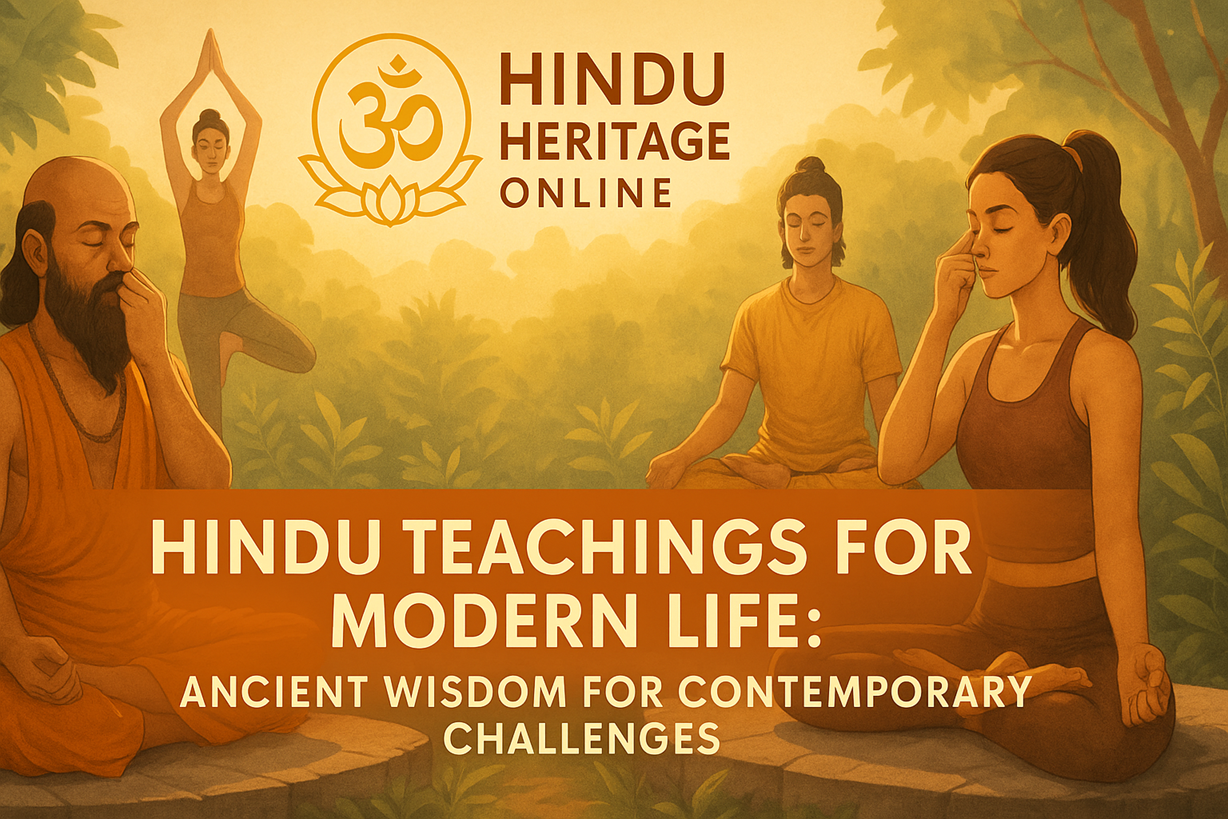
Hindu Teachings for Modern Life: Ancient Wisdom for Contemporary Challenges
In boardrooms and bedrooms, classrooms and kitchens, the timeless principles of Hindu philosophy offer profound solutions to the challenges we face in our hyperconnected, rapidly changing world. Far from being outdated religious concepts, Hindu teachings for modern life provide a sophisticated framework for navigating contemporary issues with wisdom, integrity, and inner peace.
The Relevance Crisis: Why Ancient Wisdom Matters Today
Our modern world presents unprecedented challenges: information overload, decision fatigue, work-life imbalance, environmental crisis, and the constant pressure to succeed in an increasingly competitive landscape. While technology has solved many problems, it has also created new forms of stress and disconnection that our ancestors never faced.
Hindu philosophy offers tested solutions because it addresses the fundamental aspects of human nature that remain constant across millennia. The principles of dharma, karma, mindfulness, and spiritual growth provide a stable foundation in an unstable world, helping us maintain our center while adapting to change.
Business Ethics and Professional Success: The Dharmic Approach
Building Character-Based Leadership
In the corporate world, where quarterly profits often overshadow long-term sustainability, Hindu business ethics offers a refreshing alternative based on dharmic principles. The concept of dharma in business means conducting affairs with integrity, considering the welfare of all stakeholders, and building sustainable enterprises that serve society.
Practical Applications in Business:
Truth in Communication (Satya): Be honest in all business dealings, even when it’s financially disadvantageous in the short term. This builds trust and creates lasting relationships that ultimately prove more profitable.
Non-harm (Ahimsa): Consider the impact of business decisions on employees, customers, communities, and the environment. Companies practicing dharmic principles often discover that ethical practices lead to better long-term results.
Duty and Excellence (Dharma): Perform your professional responsibilities with full commitment, regardless of immediate recognition or reward. This karma yoga approach often leads to unexpected opportunities and career advancement.
Case Study Application: When facing ethical dilemmas, ask yourself: “What would be the dharmic response?” This question often reveals solutions that satisfy both practical needs and moral requirements.
Stress Management: The Hindu Way to Inner Peace
Ancient Practices for Modern Anxiety
The epidemic of stress, anxiety, and burnout in modern society finds powerful remedies in traditional Hindu practices. Stress management Hindu way doesn’t require retreating from the world but rather engaging with it from a place of inner strength and clarity.
Yoga and Pranayama for Daily Life:
- Practice morning asanas (postures) to prepare your body and mind for the day’s challenges
- Use pranayama (breathing exercises) during stressful moments to maintain equanimity
- Incorporate brief meditation sessions into your workday for mental clarity and emotional balance
The Philosophy of Detachment: Krishna’s teaching about performing action without attachment to results provides a powerful tool for reducing work-related stress. When you commit fully to your efforts while releasing anxious attachment to specific outcomes, you experience both greater effectiveness and inner peace.
Practical Technique: Before important meetings or challenging conversations, spend a few minutes practicing detached engagement: “I will give my best effort and accept whatever results arise, knowing that I cannot control all variables.”
Relationship Wisdom: Seeing the Divine in Others
Transforming Personal and Professional Relationships
Hindu teachings emphasize that every individual carries divine essence, fundamentally transforming how we approach relationships. This perspective, known as “Namaste” consciousness, revolutionizes both personal and professional interactions.
In Marriage and Family:
- Practice seeing your partner’s highest potential rather than focusing on temporary flaws
- Apply karma yoga by serving family members without keeping score of reciprocation
- Use dharmic principles to resolve conflicts with wisdom rather than emotional reactivity
In Professional Relationships:
- Treat colleagues and employees as whole human beings, not merely functional resources
- Practice compassionate leadership that considers individual strengths and development needs
- Build team dynamics based on mutual respect and shared purpose
Community Engagement: The concept of “Vasudhaiva Kutumbakam” (the world is one family) encourages us to extend our circle of concern beyond immediate self-interest, creating more harmonious and sustainable communities.
Spiritual Growth in a Material World
Integrating Sacred and Secular
One of the most powerful aspects of ancient wisdom modern application is the integration of spiritual growth with material responsibilities. Hindu teachings don’t require renouncing worldly life but rather approaching it with spiritual awareness.
Daily Spiritual Practices for Busy Lives:
Morning Intention Setting: Begin each day by dedicating your efforts to something greater than personal gain. This simple practice transforms routine activities into spiritual practices.
Mindful Work: Approach professional tasks as opportunities for self-improvement and service to others. This attitude makes even mundane work meaningful and fulfilling.
Evening Reflection: Spend a few minutes each evening reviewing the day through the lens of dharmic principles. What did you learn? How did you grow? How did you serve?
Sacred Reading: Regularly study texts like the Bhagavad Gita, Upanishads, or other spiritual literature, applying their insights to current life situations.
Managing Material Success and Spiritual Values
The pursuit of dharma in modern life doesn’t require poverty or asceticism. Hindu philosophy recognizes four legitimate life goals:
- Dharma (righteous living)
- Artha (material prosperity)
- Kama (fulfillment of desires)
- Moksha (spiritual liberation)
The key is pursuing material success within dharmic boundaries while maintaining spiritual perspective. This balanced approach often leads to more sustainable success and greater life satisfaction.
Technology and Mindfulness: Digital Dharma
Conscious Technology Use
In our digital age, mindfulness Hindu tradition offers wisdom for healthy technology relationships. The principles of moderation, intentional action, and present-moment awareness help us use technology skillfully rather than being used by it.
Practical Guidelines:
- Begin and end each day with technology-free time for reflection and connection
- Practice conscious consumption of information, choosing quality over quantity
- Use digital tools to support dharmic goals rather than distract from them
- Create boundaries that preserve time for relationships, nature, and inner development
Emotional Intelligence Through Spiritual Practice
Hindu psychology, particularly as expressed in texts like the Bhagavad Gita, provides sophisticated tools for understanding and managing emotions. Rather than suppressing feelings, these teachings help us observe emotions with detachment, learn from them, and respond rather than react.
The Three Gunas in Emotional Management:
- Recognize rajasic emotions (anger, passion, restlessness) and channel them constructively
- Transform tamasic states (depression, lethargy, confusion) through activity and inspiration
- Cultivate sattvic qualities (peace, clarity, compassion) through spiritual practice and wise choices
Environmental Consciousness: Ancient Ecology
Hindu philosophy has always emphasized the interconnectedness of all life, making environmental consciousness a natural expression of spiritual understanding. Hindu philosophy daily life includes:
- Practicing gratitude for natural resources and using them mindfully
- Recognizing the divine presence in nature and treating the environment as sacred
- Understanding that harming the environment ultimately harms ourselves
- Living simply and sustainably as expressions of spiritual values
Creating a Dharmic Lifestyle
Practical Implementation
Transforming your life through spiritual practices modern world doesn’t require dramatic changes but rather consistent application of dharmic principles:
Weekly Structure:
- Monday: Set intentions for the week based on dharmic goals
- Wednesday: Mid-week reflection and course correction
- Friday: Gratitude practice and preparation for rest
- Sunday: Deeper spiritual study and planning
Monthly Practices:
- Review your life goals against dharmic principles
- Assess how well you’re balancing material and spiritual pursuits
- Plan service activities that contribute to others’ welfare
- Study new aspects of Hindu philosophy relevant to current challenges
The Integration Challenge
The ultimate goal of applying Hindu teachings modern life is integration – living in a way where spiritual principles and practical effectiveness support each other. This integration typically develops gradually through consistent practice, patient self-observation, and commitment to growth.
Remember that these teachings are not rules to follow blindly but principles to test through experience. What works for you may differ from what works for others, and your practice will evolve as you deepen your understanding and change your life circumstances.
The Transformation Promise
When authentically applied, Hindu teachings don’t just improve external circumstances – they transform our relationship with life itself. Challenges become opportunities for growth, work becomes service, relationships become expressions of divine love, and daily life becomes a spiritual practice.
The ancient rishis (sages) who developed these teachings faced human challenges fundamentally similar to ours: how to live meaningfully, love deeply, work effectively, and grow spiritually while navigating the complexities of material existence. Their wisdom, tested across thousands of years and millions of lives, offers us a proven path to both worldly success and spiritual fulfillment.
As you begin implementing these teachings, start small but be consistent. Choose one or two principles that resonate most strongly with your current situation and practice them daily. Over time, you’ll discover that ancient wisdom modern application creates a life of greater peace, purpose, and authentic success than you might have previously imagined possible.
The journey of applying Hindu philosophy to modern life is itself a dharmic path – a commitment to growth, service, and truth that benefits not only yourself but everyone whose life you touch. In this way, your personal transformation becomes a contribution to the collective awakening that our world desperately needs.